
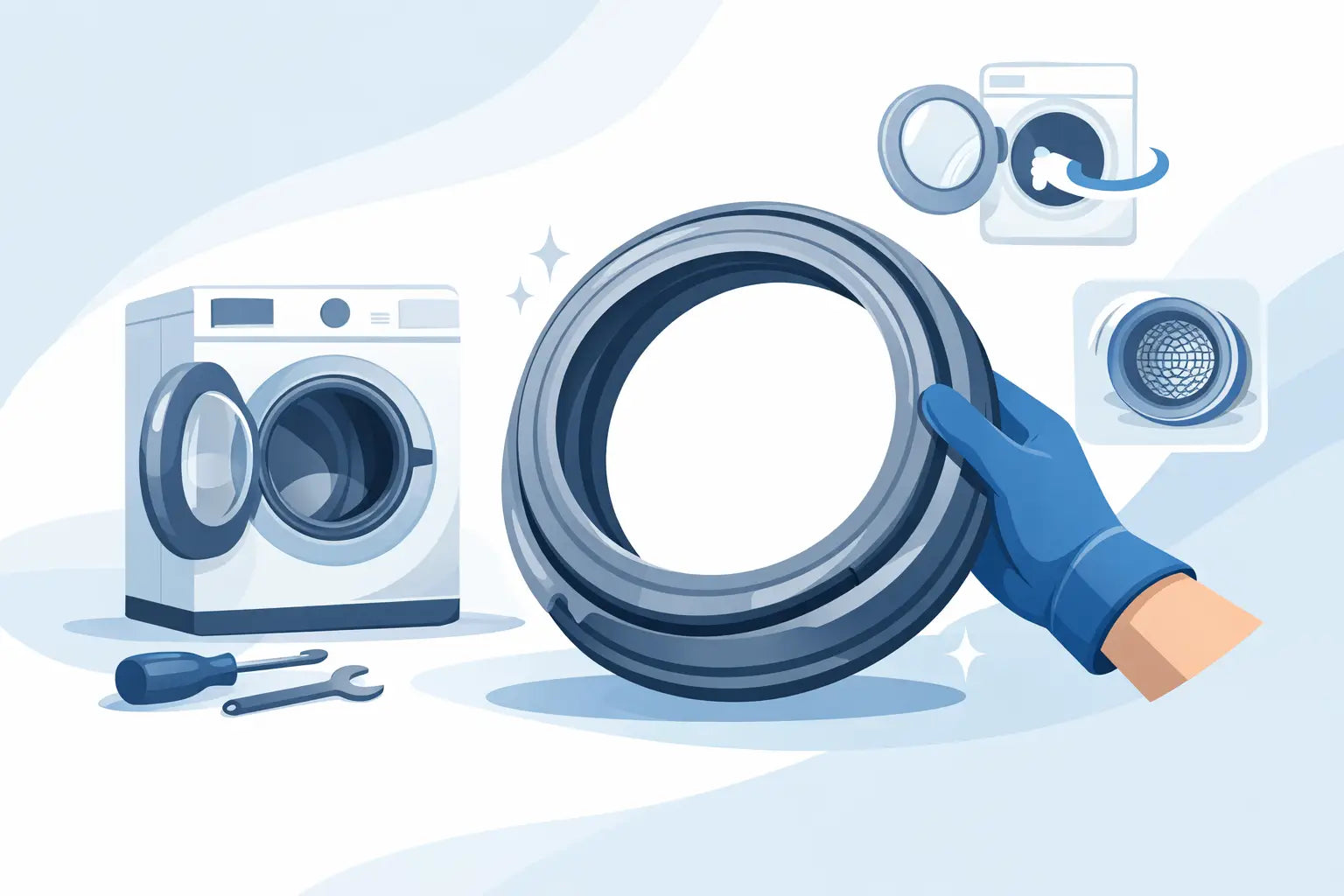
A leaking front-loading washer rarely starts with a major breakdown. More often, it starts with a split, warped or mould-stained rubber gasket that no longer seals the door properly. If you are looking for a washing machine door seal replacement part, the main job is not guessing - it is matching the correct seal to the exact make and model so you can stop the leak and get the machine back into everyday use.
For most households, a worn door seal is the kind of fault that feels bigger than it is. Water on the floor, trapped odours, black marks around the drum opening and clothes catching on damaged rubber can make the whole appliance seem finished. In many cases, though, replacing the seal is far cheaper than replacing the washing machine, and it solves a problem that only gets worse if left alone.
What a washing machine door seal replacement part actually does
The door seal, sometimes called the door gasket, sits between the drum opening and the machine cabinet. Its job is simple but essential. It creates a watertight barrier while still allowing the door to close and open normally.
Because it is flexible rubber, it also has to cope with regular movement, detergent residue, moisture and the occasional sharp edge from zips, coins or underwires. Over time, that wear shows up as tears, distortion, hardening or staining. Once the seal stops sitting correctly, water can escape during a cycle, and the washer becomes unreliable very quickly.
Some seals also include drain holes, moulded lips, spouts or ports that work with the machine’s design. That is why a part that looks almost right often is not right at all. Even a small difference in shape or fitting position can stop the door from sealing properly.
Signs you need a washing machine door seal replacement part
The most obvious sign is water leaking from the front of the machine, especially during a wash or spin cycle. But that is not the only clue. A damaged seal can show itself in quieter ways before a full leak appears.
If you notice black mould that will not clean off, cracks in the rubber folds, a flap of torn gasket near the drum, or a musty smell that keeps returning, the seal may already be past its best. Clothes coming out marked, snagged or damp around the door area can also point to a seal that has shifted or split.
It is worth checking the seal carefully before ordering any other part. Front leaks are sometimes blamed on the door lock, dispenser drawer or hose connections, but the gasket is one of the most common causes. A visual inspection often tells you a lot.
Why exact model matching matters
This is where many buyers lose time. Washing machine seals are not universal in the way some people expect. Two machines from the same brand can use different door seals, even if they look nearly identical from the front.
Manufacturers change fixing rings, lip depth, drain channels and mounting points across model ranges. That means the safest route is to match the replacement part using the appliance model number, and where possible, the serial or production code as well. If you skip that step and buy based on appearance alone, you can easily end up with a seal that does not fit the drum or the front panel correctly.
For UK households trying to fix a machine quickly, that matters. The right part gets the job moving. The wrong part means waiting again, rechecking numbers and putting up with a washer that is still out of action.
Where to find the model number on your washing machine
Most washing machine model numbers are shown on a rating plate or sticker. On many front-loading machines, you will find it around the door opening, behind the door itself, on the rear panel, or occasionally near the filter flap.
The full identification often includes the brand, model number and a longer serial code. It is worth copying the details exactly as shown, including any dashes, letters or version numbers. A missing character can point to the wrong seal.
If the label is worn or hard to read, take a clear photo before you search. That tends to be easier than writing it down in poor light, especially if the machine is fitted under a worktop.
Brand and compatibility checks
A door seal replacement part must match more than just the brand badge. Beko, Bosch, Hotpoint, Indesit, Hoover, Candy, Zanussi and other major brands all have multiple seal designs across their ranges. Some machines share components, while others do not, even within the same manufacturer group.
That is why shoppers usually get better results when they search by full model reference rather than by brand name alone. If you only search for a Bosch or Beko door seal, you may see several similar options. If you search with the exact model, you narrow it down far more quickly and reduce the risk of ordering the wrong part.
For a retailer such as Spares Direct Oldham, that model-led approach is what makes online spare part buying more practical. It saves guesswork and gives customers a clearer route to the correct replacement.
Genuine or compatible part - which makes sense?
It depends on the machine and on your priorities. A genuine manufacturer part offers the closest match to the original specification and is often the first choice if you want like-for-like fitting. That can be useful for newer appliances or models with more specific gasket designs.
A quality compatible part can still be a sensible option, particularly where it has been produced to fit a known range of models properly and offers good value. For many households, price and speed matter just as much as the badge on the packet. If a compatible seal is correctly matched and made to the right dimensions, it can be a cost-effective repair.
The key point is not simply genuine versus compatible. It is whether the part is confirmed for your exact machine.
Can you replace a washing machine door seal yourself?
Many people can, but it is not the quickest appliance repair if you have never done one before. On some models, replacing the gasket is fairly manageable with basic tools and patience. On others, accessing the inner clamp and fitting the seal evenly can be awkward, especially if the front panel design is tighter.
You need to remove the old seal, clean the seating area, align the new one properly and refit the retaining bands without twisting the rubber. If the seal is not seated evenly, it may leak straight away or rub against the drum.
For confident DIY users, the savings can be worth it. For others, ordering the correct part and having a local engineer fit it may still be the best route. The important thing is that the machine is repaired with the right gasket rather than being written off too early.
Common mistakes when ordering a door seal
The biggest mistake is buying by photo only. Door seals are one of those parts that can look almost identical online and still be wrong in practice. The second is searching by a shortened model number and ignoring the full code on the rating plate.
Another common issue is assuming the leak must mean any gasket from the same brand will do. It will not. Front-loading washers are more model-specific than that. Finally, some buyers replace the seal without checking for damage caused by a foreign object, such as a bra wire or coin lodged between the drum and gasket. If the cause is still present, the new seal may be damaged again.
Is replacing the seal worth it?
In most cases, yes. A door seal is usually a sensible repair when the rest of the washing machine is working properly. If the motor, drum and controls are all sound, changing a worn gasket can extend the life of the appliance at a modest cost.
There are exceptions. If the machine also has major bearing noise, electrical faults or multiple worn components, you may need to weigh up the total repair cost. But for a straightforward front leak or visible gasket damage, replacing the seal is often one of the more practical and affordable fixes.
It also makes sense from a day-to-day point of view. A washing machine that smells damp, leaks on the kitchen floor or catches clothes is not just inconvenient - it disrupts the routine of the whole household.
Choosing the right part without wasting time
The fastest route is usually the simplest one. Start with the full model number, check whether the seal is listed specifically for that appliance, and avoid vague matches. If the product description refers to exact compatibility, that is usually a far better sign than a generic listing with broad claims.
If your current seal has a visible tear, heavy mould, loose retaining edge or distorted shape, do not wait for a complete failure. Ordering the correct replacement early often prevents a smaller issue from turning into a bigger clean-up job.
A washing machine does not need to be perfect to keep going, but the door seal does need to do its job properly. Get the match right, and a simple replacement part can put a leaking machine back into reliable daily use without the cost of a full appliance replacement.
When a washer starts leaking at the front, the best fix is often the most straightforward one - identify the exact model, choose the correct seal, and get the machine back to doing what it is supposed to do.