
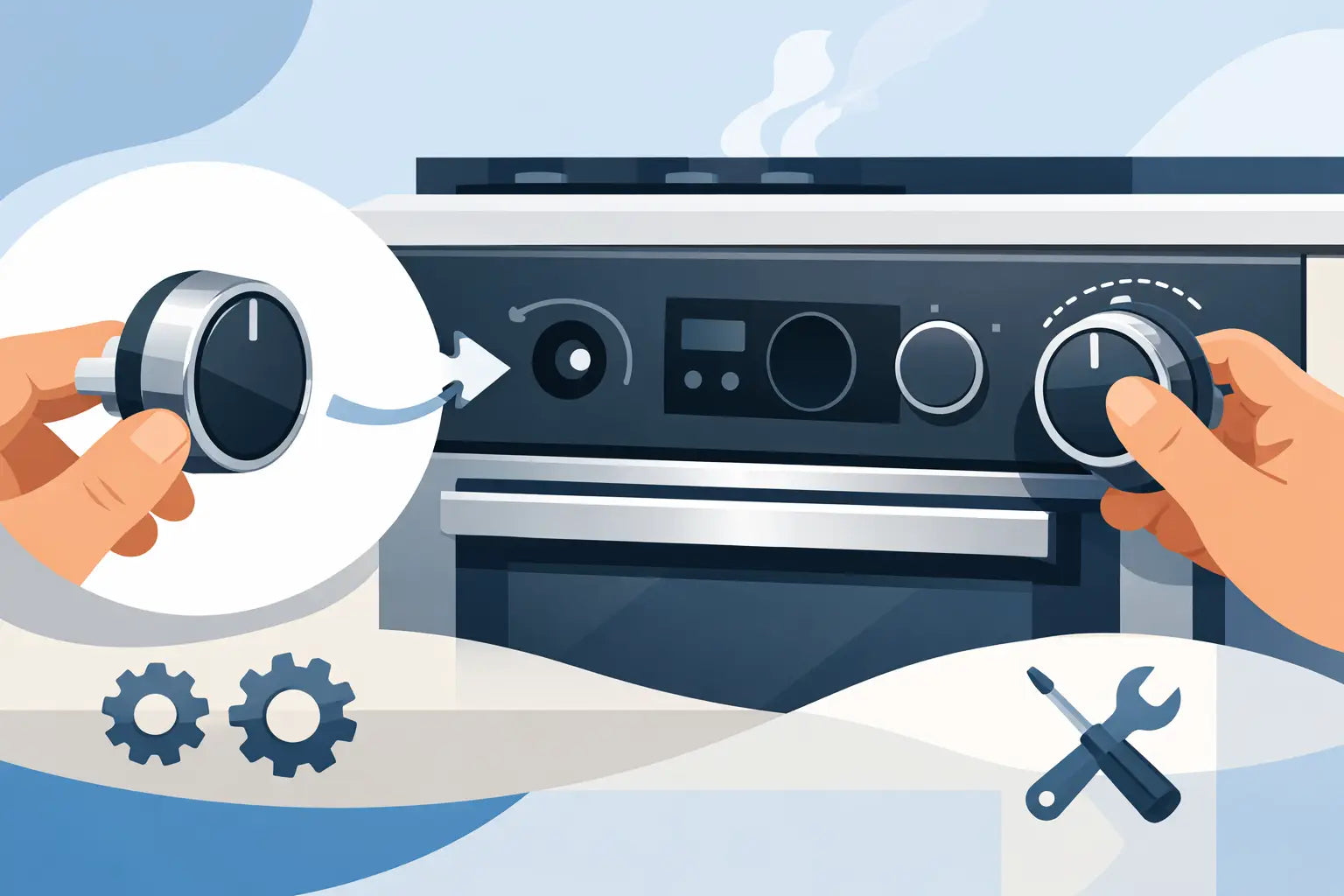
A Bosch oven knob can come away in your hand after years of daily use, crack around its centre fitting or simply go missing during a clean. The good news is that fitting a replacement is usually a quick job. Knowing how to fit Bosch oven knob correctly helps you avoid damaging the control spindle, fitting it at the wrong angle or ordering a part that only looks similar.
Most oven control knobs are push-fit parts. They slide onto the metal control shaft behind the cooker fascia, with no screws or specialist tools required. The key is matching the knob to the appliance model and fitting it gently in the correct off position.
Before fitting a Bosch oven knob
Turn the oven controls to the off position and allow the appliance to cool fully. For extra peace of mind, switch the cooker off at the mains isolator before working around the control panel. This is particularly sensible if the old knob has broken and you need to inspect the shaft closely.
Do not pull on, twist or bend the exposed spindle. It is part of the oven's control switch or thermostat, and damage to it can turn a simple replacement into a larger repair. A clean, dry cloth is normally all you need to wipe away grease or food residue from the area.
Take a moment to check the original knob, if you still have it. Look at its shape, colour, marker line and the fitting on the rear. Bosch knobs can appear alike from the front, but their shaft fitting, depth and markings may differ between cooker, built-in oven and hob models.
Find the correct appliance model number
The most reliable way to choose a Bosch replacement knob is by using the appliance's model number, often called the E-Nr. On many Bosch ovens, this is found on the rating plate around the oven door opening. Open the door and check the inner frame or side edge. Depending on the model, it may also be on the side or back of the appliance.
Make a note of the complete E-Nr, including the characters after the slash where shown. Those extra details can matter. A knob that fits a similar-looking Bosch oven may sit too loosely, be too deep for the shaft or point to the wrong setting.
If you are replacing more than one knob, compare each control carefully. The oven function selector, temperature control, timer and hob controls may use different markings or fittings even when they are on the same appliance.
How to fit Bosch oven knob safely
Once you have a compatible knob, fitting it should take only a few minutes.
1. Set the control shaft to off
With the old knob removed, identify the control spindle sticking out from the fascia. Carefully turn it only if necessary to place the control in its off position. The exact position varies by model, but it is commonly at the top of the dial.
Avoid using pliers or gripping the shaft hard. If the spindle feels stiff, do not force it. A stiff or damaged switch may need further attention before a new knob is fitted.
2. Check the rear of the new knob
Turn the replacement knob over and inspect the hole in the back. It may be a D-shaped opening, a flat-sided fitting or another moulded profile designed to line up with the shaft. The marker line on the front should be easy to see.
Hold the knob in front of the spindle without pushing it on. This lets you check which way it needs to face when the control is off. On most Bosch designs, the indicator line should align with the off mark on the fascia once fitted.
3. Align the fitting with the spindle
Line up the internal shape of the knob with the shape of the shaft. If the shaft has a flat edge, rotate the knob until its matching flat section meets it. The knob should sit squarely against the control panel rather than at an angle.
This is where people most often go wrong. If the knob will not start to slide onto the shaft with light pressure, it is probably not aligned. Remove it, rotate it slightly and try again. Forcing a mismatched fitting can crack the new knob or damage the switch behind it.
4. Push the knob on evenly
Press the knob straight towards the fascia with steady, gentle pressure. It should slide on smoothly and stop at its natural depth. There should be a small, even gap or a neat close fit depending on the Bosch model, but it should not wobble or scrape the control panel when turned.
Do not use a hammer, screwdriver or any adhesive. A correctly matched push-fit Bosch knob does not need them. Glue can make future removal difficult and may prevent the knob from sitting correctly.
5. Test the movement and pointer position
Turn the fitted knob slowly through its normal range, then return it to off. It should rotate without sticking and the pointer should correspond with the symbols or temperature marks on the fascia.
If the line is pointing between settings, the knob may not be fully seated or it may not be the correct version for your appliance. Take it off gently and recheck the alignment. If it still sits incorrectly, stop using it until compatibility has been confirmed.
If the old Bosch knob is stuck or broken
A worn knob normally pulls straight off. Grip it firmly at the base and pull directly towards you while applying a small, controlled wiggle. Do not lever it away from the panel with a knife, screwdriver or other metal tool, as this can mark the fascia or put pressure on the control shaft.
If only the outer part has snapped off, inspect the remaining plastic around the spindle. Small fragments can usually be removed carefully by hand. If the broken section is tightly wedged, or if the shaft itself is bent, loose or pushed back into the panel, it is best not to continue. The fault may be with the control switch rather than the knob.
A knob that turns but does not change the oven setting can also indicate a stripped internal fitting. Replacing the knob may solve the problem if the metal spindle still turns normally. If the spindle turns freely without changing the setting, however, a new knob alone is unlikely to fix it.
Common fitting problems and what they mean
A loose knob is often a compatibility issue. It may have the wrong internal profile or be designed for a different shaft size. It can also mean the knob has not been pushed fully home, so remove it and check for debris around the shaft.
A knob that will not go on at all is usually misaligned or incorrect for the model. Never widen the hole, cut the plastic or press excessively hard to make it fit. Replacement parts are designed to match particular appliances, and adapting a knob can leave you without reliable control of oven settings.
If the pointer is wrong but the knob fits securely, compare the markings with your original. Function-selector knobs can look very similar while using different symbol layouts. A temperature knob from another Bosch range may physically fit but display the wrong temperatures.
Heat damage is another reason to replace a knob. If the plastic is discoloured, soft, split or repeatedly loosens after use, check that the oven door seal closes properly and that heat is not escaping around the control panel. A new knob will restore a usable control, but it will not cure an underlying overheating issue.
Choosing a replacement that will last
For the best fit, choose a Bosch knob listed specifically for your E-Nr or confirmed compatible appliance model. Match the control type as well as the finish. Black, silver, stainless-effect and white knobs can vary in profile, and a neat match helps keep the cooker easy to read and use.
It is worth replacing a damaged knob promptly rather than managing with a loose fitting or turning the shaft by hand. Clear controls make everyday cooking safer, especially when several people use the same kitchen. Spares Direct Oldham stocks practical replacement parts for major household appliances, helping you restore a familiar cooker without the cost of replacing it.
Once the knob is seated squarely, turns cleanly and points accurately to off, the job is done. Keep the model number somewhere handy for future repairs - it can save a great deal of guesswork when another small appliance part needs replacing.