
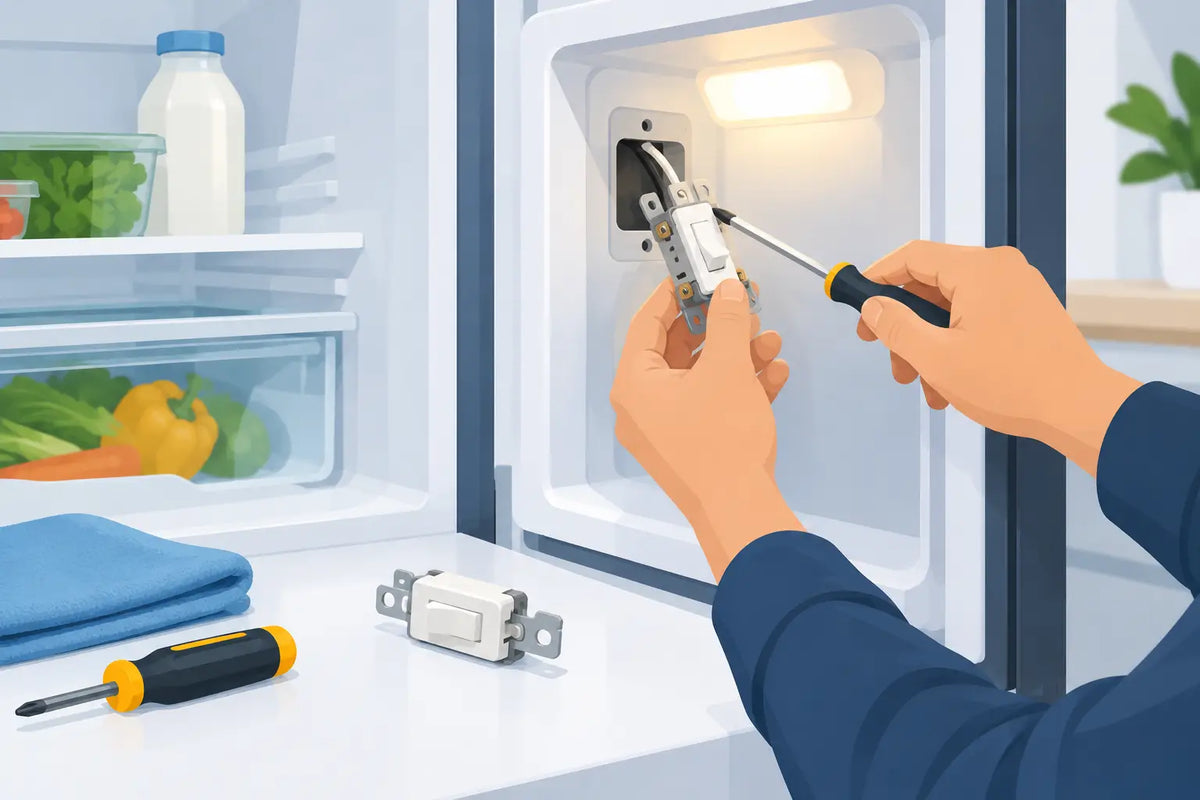
A fridge light that stays off when the door opens is more than a minor annoyance. It makes shelves harder to see, can hide spills and expired food, and may leave you wondering whether the appliance has a wider electrical fault. Before assuming the bulb has failed, check the door-operated switch. In many cases, knowing how to replace the fridge light switch is the straightforward fix that restores normal use without the cost of a new appliance.
The small switch is usually fitted inside the fridge compartment, close to the top or along the door frame. When the door closes, it is pressed in and turns the light off. When the door opens, it releases and completes the circuit to the lamp. After years of use, the mechanism can stick, wear out or lose its electrical connection.
Check the switch before ordering a replacement
Start with the simplest checks. If your fridge uses a replaceable bulb, turn off the appliance at the socket, remove the lamp cover and inspect the bulb. A darkened bulb, loose fitting or broken filament points to the bulb rather than the switch. If you have a suitable matching bulb, fitting it is a quick way to rule this out.
If the bulb appears sound, press the fridge light switch in and release it several times. A working switch should move freely and make the light go off when pressed, then come back on when released. A switch that feels loose, remains jammed in, has no positive movement or only works when pressed at a certain angle is likely faulty.
There is another useful test. With the door open, carefully hold the switch in. If the light stays on, the switch may not be the cause. If the light changes only when you wiggle the switch, or does not respond at all while a known-good bulb is fitted, replacement is usually sensible.
A light that remains on with the door shut can also indicate a failed switch. Do not leave this unresolved. Constant heat from an older bulb can affect the temperature inside the fridge and waste electricity. On models with LED lighting, the fitting produces less heat, but a permanently illuminated light still needs investigation.
Find the correct fridge light switch
A fridge light switch is not always a universal part. They can differ in physical shape, terminal layout, mounting clips, actuator length and electrical rating. Two switches may look almost identical yet not lock into the housing or connect safely to the appliance wiring.
The best starting point is the fridge model number, not the brand alone. Look for the rating plate inside the fridge compartment, often on a side wall behind the salad drawer, near the crisper area or around the door opening. Some appliances place it behind a lower kick plate or on the rear exterior. Record the full model number exactly, including any letters, hyphens and digits.
Also check the old switch where possible. A part number may be moulded into the plastic body or printed on its label. Matching this number gives the strongest chance of receiving the correct replacement. If the switch has to come out before you can read it, take a clear photograph of the fitting, terminals and wire positions first.
When comparing a replacement, confirm that it is listed for your appliance model or that its part number supersedes the original. Pay attention to whether it is a push-button switch, plunger switch or a switch built into a larger lamp housing. Some fridge-freezers use a combined assembly, so the individual switch is not designed to be changed on its own.
Spares Direct Oldham helps practical households source replacement appliance parts by model, making it easier to match a compatible part rather than relying on appearance alone.
What you need before you start
For many standard switches, the job requires only a small flat-blade screwdriver, a Phillips screwdriver and a torch. A pair of needle-nose pliers can be useful if the terminals are tight, but avoid pulling wires with force. Keep a mobile phone nearby to photograph each stage before disconnecting anything.
Most importantly, isolate the appliance from the mains supply. Unplug the fridge from the wall socket before removing the lamp cover, switch or any internal trim. Do not rely solely on turning the temperature control to off, as the appliance may still be live. If access to the plug is awkward, switch off the correct circuit at the consumer unit and make sure nobody turns it back on while you are working.
Move chilled food to a cool bag or keep the door open only as long as necessary. This repair is often quick, but there is no reason to leave the fridge standing open while searching for tools.
How to replace a fridge light switch
Remove the lamp cover and access the switch
With the appliance unplugged, remove the light cover if it obstructs the switch. Covers may unclip, slide sideways or be retained by one or two screws. Use gentle pressure only. Brittle plastic can crack, especially on an older fridge, and replacement covers can be more difficult to identify than the switch itself.
The switch may be held in place by clips that release when the body is pushed from the rear, or it may have a retaining screw. On some models, a small surrounding trim panel needs to be removed first. Check carefully for hidden screws and avoid levering hard against the fridge liner.
Photograph and disconnect the terminals
Before removing wires, take a close photograph that shows every terminal and wire colour. Fridge light switches commonly have two connections, but some have additional terminals depending on the design. The wires must return to the same terminals on the new component.
Pull insulated spade connectors from the terminal itself, not from the wire. If a connector is stubborn, use pliers lightly on the metal connector while supporting the switch. Never cut wires simply to speed up the repair. Damaged or shortened wiring can turn a simple replacement into a more involved electrical repair.
Fit the new switch securely
Connect each wire to the matching terminal on the replacement switch, using your photograph as a reference. Push connectors on fully so they sit firmly. Then locate the switch in the opening, ensuring its button or plunger faces the door correctly and the retaining clips or screw are fully engaged.
Refit any trim and the lamp cover. Check that no wiring is trapped behind the cover or caught by the switch body. A switch that is not seated squarely may work at first but fail to operate when the fridge door closes.
Test it with the appliance powered again
Reconnect the appliance at the socket. Open the door and confirm that the light comes on. Then press the switch by hand: the light should go out immediately and return when you release it. Finally, close the door gently and check that it presses the switch fully.
If the light remains off, turn the power back off before investigating. Recheck the bulb or LED module, the terminal positions and the condition of the connectors. If the replacement switch fits but the fault remains, the issue may be in the lamp assembly, wiring, control board or door alignment rather than the switch.
When not to tackle the repair yourself
Replacing an accessible push switch is usually manageable for a careful DIYer. It is not the right job to force if the wiring is damaged, the switch sits behind sealed insulation, there is evidence of scorching, or the appliance trips the electrics when powered. Stop work if you see melted plastic, a burnt smell, loose bare wire or moisture around electrical connections.
Integrated appliances can be more awkward because access panels and lamp housings vary by model. Fridges with electronic controls or sealed LED modules may also need a specific complete assembly. In these cases, matching the exact model and part number matters even more, and a qualified appliance engineer may be the safer option.
A working fridge light should be a small repair, not a reason to replace an otherwise reliable appliance. Take a moment to identify the fault, order the right model-compatible switch, and fit it with the power isolated. That simple approach can bring the fridge back to normal use quickly and help it serve the household for longer.