
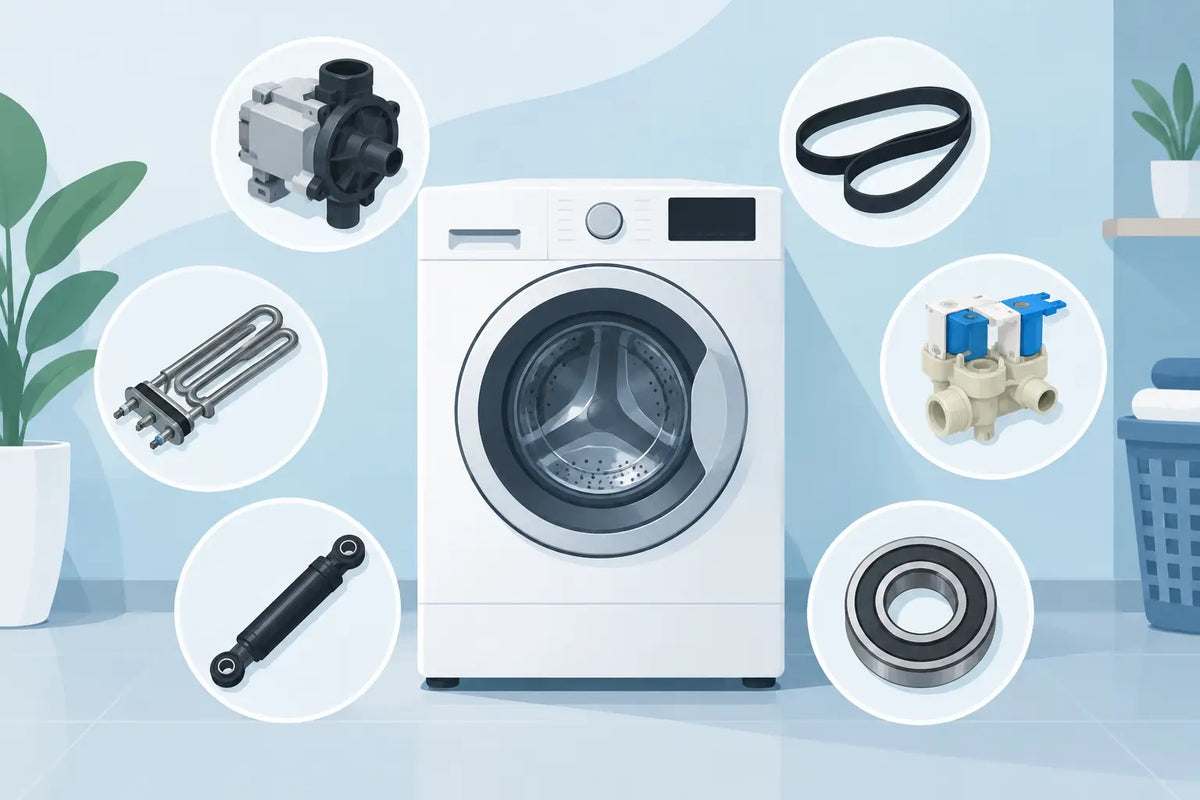
A washing machine rarely stops working without leaving clues. A new rattle on spin, water left in the drum, clothes that come out cold or a door that will not unlock can all point to a worn or failed component. Knowing what parts fail in washing machines helps you narrow down the fault before ordering a replacement or arranging a repair.
Many faults are caused by serviceable parts rather than the whole appliance reaching the end of its life. The right replacement can often get a trusted machine back in use for far less than the cost of a new one. The key is matching the part to the exact make and model number, as similar-looking components are not always compatible.
What parts fail in washing machines?
The most common failures tend to involve parts that move, heat water, control water flow or keep the machine safe while it runs. How long they last depends on the machine's age, how often it is used, water hardness, load size and whether small objects have made their way into the drum or filter.
Door lock and door handle
If the washing machine will not start, shows a door-related error code or keeps the door locked after a cycle, the door interlock is a likely suspect. This safety device confirms that the door is shut before the machine fills or spins. Over time, its internal mechanism can wear out, particularly on a busy family machine.
A broken door handle can produce the same immediate problem: the door no longer closes firmly enough to engage the lock. Check the handle, catch and hinge first. If the door looks aligned and clicks shut but the appliance still refuses to begin, the interlock may need replacing.
Always unplug the machine before inspecting or replacing a door lock. If the door is locked with water still inside, drain the appliance safely before attempting to open it.
Drain pump and filter
A machine that finishes with water in the drum, will not spin properly or makes a humming sound while draining may have a blocked filter or a failing drain pump. Coins, hair grips, buttons, fabric fibres and small items from pockets commonly collect in the pump filter.
Cleaning the filter is a sensible first step. Put down towels and use a shallow tray, as water will usually escape when the filter cap is removed. If the filter is clear but the pump still hums, leaks or does not move water through the drain hose, the pump itself may be worn or obstructed internally.
Do not keep restarting a machine that cannot drain. Repeated attempts can put extra strain on the pump and leave water sitting in the appliance.
Drive belt, motor brushes and motor faults
On many belt-driven washing machines, the belt transfers power from the motor to the drum. If you can hear the motor running but the drum does not turn, a slipped, loose or snapped belt is possible. A belt may also cause a burning-rubber smell or a drum that turns intermittently.
Older machines with carbon brushes can develop motor problems as the brushes wear down. Typical signs include weak spinning, the drum stopping mid-cycle or sparking visible around the motor area. However, many newer machines use brushless or inverter motors, so carbon brushes will not apply to every model.
A failed motor is less common than a belt, pump or lock fault and can be more expensive to diagnose. Check the simpler mechanical causes first, and do not force the drum if it feels stiff or seized.
Heating element and temperature sensor
When a washing machine appears to run normally but laundry is not being washed at the expected temperature, the heating element may have failed. The machine may also take much longer than usual to complete a programme, stop part way through, or display a heating-related fault code.
Limescale is a frequent cause in hard-water areas. It can build up on the element, making it work harder and eventually causing failure. A faulty temperature sensor, sometimes called an NTC sensor, can create similar symptoms because the machine cannot accurately measure the water temperature.
It is worth considering the programme before assuming there is a fault. Eco settings and low-temperature washes are designed to use less energy, so the door glass may not feel particularly warm. Test with a standard cotton programme at a higher temperature if the manufacturer's instructions allow it.
Water inlet valve and inlet hose
If the machine will not fill, fills very slowly or continually lets water in, look at the water supply and inlet components. Start with the basics: make sure the tap is fully open, the inlet hose is not kinked and the small mesh filter at the hose connection is not blocked with debris.
The inlet valve controls the flow of water into the appliance. A failed valve may stop water entering altogether, or it may fail to close properly and allow water to continue flowing when it should not. Constant filling needs prompt attention. Turn off the water supply to the machine and avoid using it until the cause is identified.
Detergent drawer and dispenser parts
A drawer that fills with water, leaves detergent behind or sends fabric conditioner into the drum too early is often blocked rather than broken. Dried detergent and conditioner residue can clog the drawer channels and siphon cap. Remove the drawer, clean it thoroughly and wipe the housing where possible.
If cleaning does not solve the issue, the dispenser housing, inlet jets or drawer components may be damaged. These parts are model-specific, so compare the appliance model number carefully before ordering a replacement.
Drum bearings, suspension and shock absorbers
A loud rumble during spin, excessive vibration or a drum that has noticeable side-to-side movement can indicate worn bearings. Bearing faults are more likely on older machines and may worsen gradually. You might first notice a low roaring noise at higher spin speeds, followed by rough movement when turning the empty drum by hand.
Shock absorbers and suspension springs help control the drum as it spins. When they wear out, the machine can bang, walk across the floor or shake much more than usual. Before assuming a part has failed, check that the appliance is level and stable. An uneven floor, overloaded drum or heavy item such as a bath mat can cause similar movement.
Bearings can be a bigger repair than a pump or handle. On some machines the outer tub is not designed to be easily split, which affects whether a repair is practical. This is one case where the cost of parts, labour and the appliance's age should be weighed carefully.
Hoses, door seals and leaks
Water around the front of the machine may come from a torn door seal, also known as the gasket. Look for splits, trapped objects, mould build-up or damage around the inner edge. A wire from an underwired bra, a sharp zip or a small item caught between the drum and seal can cause a leak.
Leaks from underneath may be caused by a loose or damaged drain hose, pump hose, dispenser hose or pump seal. Do not rely on the visible puddle alone, as water can travel along the base before appearing at the front. Isolate the water and electricity supply before investigating.
Control board and wiring faults
The control board is the machine's electronic control centre. A faulty board can cause unusual symptoms, such as a programme selector that does not respond, random error codes, a machine that stops at the same point every cycle or a display that remains blank despite power reaching the socket.
Because these symptoms can also be caused by a door lock, pump, heater, wiring connection or mains issue, a control board should not be the first part ordered on a guess. Check the plug socket, fuse, power cable and simpler fault signs first. Electronic parts must match the exact appliance version, not just the brand name.
How to identify the right replacement part
The model number is the most useful detail when buying washing machine spares. It is usually found on a label around the door opening, behind the filter flap, on the rear panel or in the instruction manual. Take a clear photo of the label before removing anything, as model codes can include letters and production numbers that matter for compatibility.
Also compare the old part where possible. Check connector shape, mounting points, dimensions and any printed part number. This is particularly useful for pumps, door locks, drawer parts and handles. A universal-looking item can still be wrong for your machine.
For straightforward jobs such as a filter cap, drawer insert, door handle or compatible hose, a careful homeowner may be able to fit the part. Electrical repairs, heating elements, motors and faults involving wiring or water leaks need more caution. If you are unsure, use a qualified appliance engineer. Never work on a machine that is still connected to the mains or water supply.
A washing machine fault is frustrating, especially when laundry is already piling up. Start with the symptom, check the simple causes, identify the exact model and choose a compatible replacement part. With a practical repair, many everyday faults can be resolved without replacing the whole appliance.