
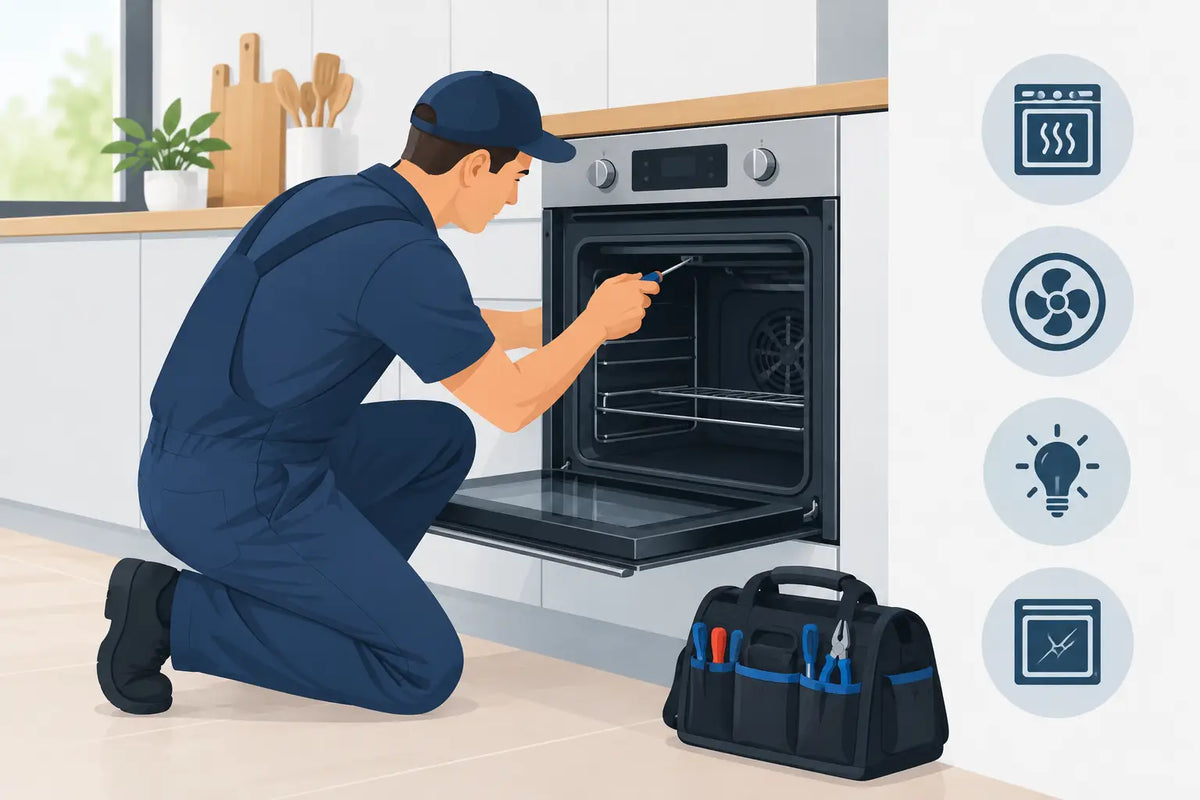
A cold oven ten minutes before dinner, a fan that suddenly becomes noisy, or a door that will not shut properly can bring the kitchen to a halt. Beko oven repair does not always mean replacing the whole cooker. In many cases, one worn or failed component is behind the problem, and fitting the correct replacement can be a practical, affordable way to get back to normal.
The key is diagnosing the fault carefully and matching any part to the full appliance model number. Ovens can look very similar from the outside while using different elements, thermostats, lamps, hinges or control parts inside. Taking a few minutes to check before ordering helps avoid delays and the cost of an unsuitable spare.
Start Beko oven repair with a safe diagnosis
Before inspecting an oven, isolate it from the electricity supply at the consumer unit or unplug it if it has a plug. Do not rely on turning the controls to off. Ovens contain high-voltage electrical components, and some parts may remain hot long after cooking.
If you smell burning, see scorch marks, notice a tripping circuit breaker, or find damaged wiring, stop using the appliance. A qualified appliance engineer should deal with electrical faults that involve wiring, connections or the cooker supply. The same applies to gas cookers and gas ovens: do not attempt a gas repair yourself.
For straightforward mechanical jobs, such as replacing an oven bulb cover, shelf support, door seal or certain hinges, a careful homeowner may be able to make the repair. It depends on the model and on how easily the component can be accessed. If removing a panel exposes wiring or insulation, it is sensible to pause and seek professional help.
Find the model number first
The full model number is the most useful detail when searching for Beko oven spares. It is usually shown on the appliance rating plate, commonly around the oven door frame, behind the door, on a side panel or in the storage drawer area on a freestanding cooker. Check the instruction manual too, but use the rating plate where possible.
Write down every letter, number and suffix. A small difference can matter. For example, two versions of the same Beko cooker range may have different fan oven elements or hinge designs. If a product listing gives compatible model references, compare them character by character with your appliance rather than relying only on photographs.
It also helps to identify the type of oven. Is it a fan oven, conventional electric oven, built-in single oven, double oven or a freestanding cooker? Knowing which cavity has the fault is particularly important on double ovens, where the top and main ovens can use different components.
Common faults and the parts often responsible
An oven fault can have more than one cause, so symptoms are a starting point rather than a guarantee. Still, a few problems occur regularly and can point you towards the parts worth checking.
The oven has power but will not heat up
If the clock, display or oven light works but the cavity stays cold, a failed heating element is a common cause. In a fan oven, the circular fan element at the rear of the cavity is often responsible for producing heat. Conventional ovens may use separate top and bottom elements.
A visible split, blister, burn mark or broken section on an element is a strong sign that it has failed. Sometimes there is no obvious damage, however. An engineer can test electrical continuity safely to confirm the fault. Do not fit an element simply because it looks broadly similar - wattage, shape, fixing points and terminal layout must match the correct Beko model.
If the oven overheats, underheats or the temperature varies wildly, the thermostat or temperature sensor may be at fault. Temperature problems can also arise from a damaged door seal allowing heat to escape. A worn seal is often easier to spot: look for flattened sections, gaps, splits or areas that no longer sit firmly against the door.
The fan runs but food cooks unevenly
A fan running does not necessarily mean the fan oven is heating properly. The fan motor may be turning while the element has failed, leaving food only partly cooked or taking much longer than expected. Conversely, a working element with a weak or noisy fan motor can lead to uneven circulation and hot spots.
Listen for scraping, rattling or a loud humming sound that was not there before. Remove shelves and trays and check that nothing is catching the fan cover. If the noise continues, the fan motor, fan blade or mounting may need closer inspection. Repairs involving the rear panel should only be carried out with the appliance fully isolated and with confidence in the procedure.
The oven light has stopped working
An oven lamp is one of the simpler replacements, but it still needs the correct high-temperature bulb. A standard household bulb is not suitable for an oven cavity and can fail quickly. Check the bulb cap type, voltage and heat rating before ordering.
If a new oven bulb does not work, the issue may be the lamp holder, wiring or door switch rather than the bulb itself. Avoid repeatedly changing bulbs without checking for signs of heat damage or a loose fitting.
The door does not close, stay shut or retain heat
A loose oven door wastes heat and can make cooking times unpredictable. Common causes include tired hinges, a broken hinge receiver, worn door catches and flattened seals. If the door drops when opened or feels heavy and uneven, hinges are a likely suspect.
Door repairs vary by model. Some hinges can be released using locking clips, while others require the door to be removed in a particular position. Refer to the appliance instructions where available and support the door carefully. Glass panels are heavier and more fragile than they look.
A replacement door seal can improve heat retention when the old one is split or no longer springs back. Before fitting a new seal, clean the channel and remove crumbs, grease and hardened residue. A seal that is fitted into a dirty groove may not sit evenly.
Knobs, dials and controls are damaged
A cracked or missing control knob can be frustrating, especially when oven settings are no longer clear. This is often a quick replacement, but the spindle fitting needs to match. Check whether the knob is a push-fit type and whether the control shaft has a D-shaped, splined or round profile.
If the knob turns but the oven does not respond, the problem may be the selector switch or thermostat behind the control panel. These parts are model-specific and their replacement can involve mains wiring, so professional fitting is usually the safer option unless you are properly experienced.
Choosing the right Beko oven spare part
Correct matching is more useful than choosing the cheapest-looking option. Start with the model number, then compare the part reference, measurements, connectors and fixing positions. For elements, look at the shape and terminal arrangement. For hinges and seals, check the side, length and fitting style. For knobs, confirm the shaft type.
Keep the old part until the replacement is fitted and tested. Comparing the two side by side can reveal a mismatch before installation. Take a clear photograph of the rating plate and, where safe, the faulty component and its connections. This makes it easier to check product details accurately.
There is a trade-off with universal parts. A universal oven bulb or shelf may be suitable when the specification matches, but functional components such as elements, fan motors, thermostats and switches are usually best selected for the exact model. A part that almost fits can create more work, and an incorrect electrical part may be unsafe.
At Spares Direct Oldham, the practical approach is to search using the appliance model details rather than guessing from the front of the cooker. This gives you the best chance of finding a compatible replacement quickly, whether you need a Beko oven element, door seal, lamp or control component.
When to repair and when to call an engineer
Repairing is often worthwhile where the oven is otherwise in good condition and the fault is limited to a replaceable part. A new seal, bulb, knob, shelf support or element can extend the life of an appliance for a modest outlay compared with replacing a cooker.
Call an engineer if the oven repeatedly trips the electrics, gives an electric shock, has burnt wiring, shows an error code you cannot clear, leaks gas, or needs internal wiring work. It may also be better to seek advice if several faults appear at once, particularly on an older appliance. A single failed component is one thing; repeated failures can indicate a wider issue.
After any repair, refit all covers, make sure screws are secure and test the oven cautiously. Check that the door closes properly, controls operate as expected and the oven heats without unusual smells, noise or electrical problems. Never leave the appliance unattended for its first test run after work has been carried out.
A careful model-number check and the right replacement part can turn an inconvenient oven fault into a manageable repair, helping you keep a familiar appliance working when you need it most.