
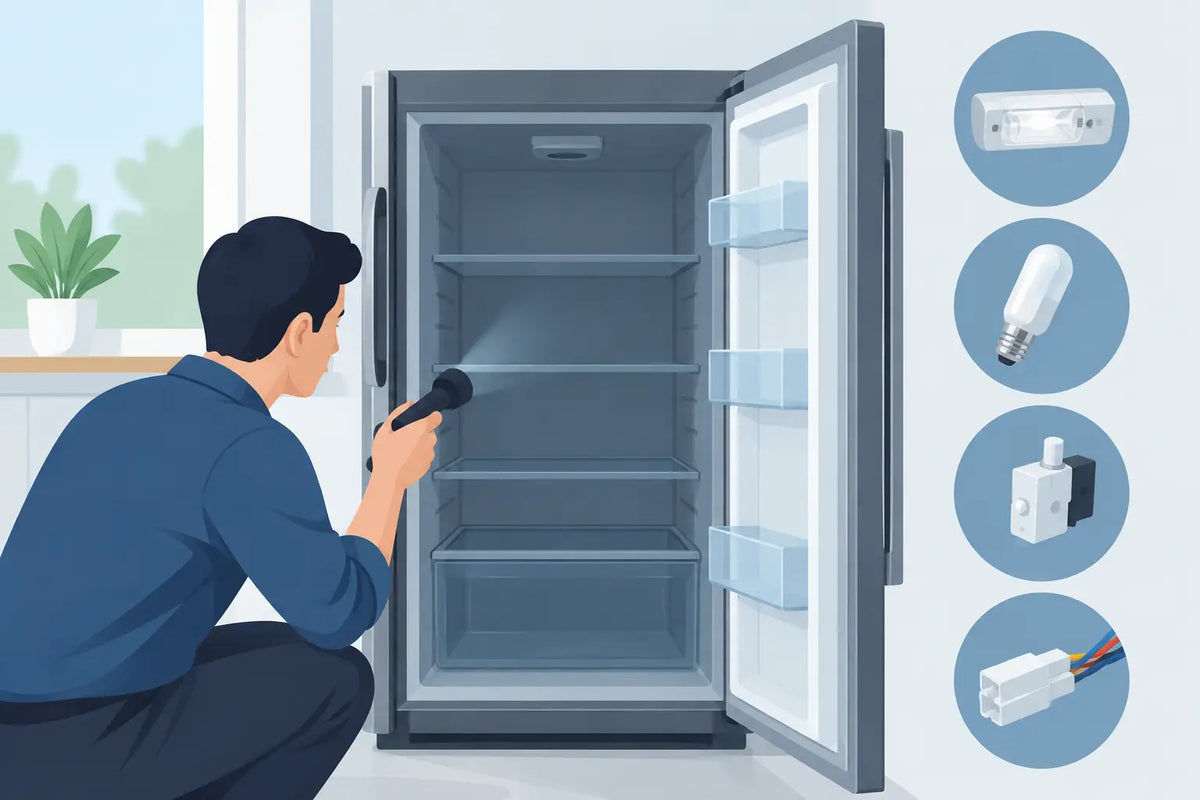
You open the fridge for the milk, the appliance is humming as normal, but the interior is completely dark. If you are wondering why fridge light stays off, the cause is often a small, replaceable part rather than a fault with the whole appliance. A failed bulb, worn door switch or LED module can leave a perfectly cold fridge without any light.
The sensible approach is to check the simplest causes first, then use your fridge model number to match any replacement part accurately. Do not assume every fridge uses a standard bulb - many newer models use a model-specific LED unit or light housing.
Why fridge light stays off when the fridge still works
When the fridge is cooling normally but the light does not come on, the refrigeration system is usually not the issue. The light circuit is separate from the compressor and thermostat controls, so a dark interior does not automatically mean an expensive repair.
In many cases, the problem is one of three things: the bulb has failed, the door switch is stuck or damaged, or the light fitting itself has developed a fault. Older appliances are more likely to have a screw-in appliance bulb. Newer fridge freezers often have LEDs built into a plastic module, usually at the top or side of the fridge compartment.
Before touching any fitting, switch the appliance off at the mains and unplug it. This is especially important if you are removing a cover, checking a switch or looking at wiring. If there is any sign of scorching, loose wiring, water around electrical components or a burning smell, stop and arrange for a qualified appliance engineer to inspect it.
Check whether the bulb has failed
A conventional fridge bulb is the quickest place to start. With the fridge unplugged, remove the lamp cover if your model has one. Covers can clip, slide or screw into place, so avoid forcing it. If it is stiff, check for a small retaining tab or screw.
Remove the bulb and inspect it. A broken filament, darkened glass or loose metal base suggests it has reached the end of its life. However, a bulb can fail without obvious visible damage. If you have an identical known-working appliance bulb, you can test the fitting with it once everything is reassembled.
Do not fit an ordinary household bulb simply because it has the same screw fitting. Fridge bulbs are designed to cope with low temperatures and frequent switching. They also need the correct wattage and physical size for the lamp cover. A bulb that is too powerful can generate excess heat, while one that is too large may damage the cover or not fit correctly.
Look for the wattage, cap type and any markings printed on the old bulb or in the appliance handbook. If the original bulb is missing, the fridge model number is the safer route to finding the correct replacement.
If your fridge uses an LED light
LED fridge lights can last for years, but they do fail. Unlike a standard bulb, an LED assembly may be a complete module containing LEDs, a diffuser and connections. Some are held in by clips; others are secured with screws or sit behind a shaped cover.
A dim, flickering or intermittently working light often points to a failing LED module rather than a door switch. If the light stays completely off, it could still be the module, but check the switch before ordering a part. LED modules are usually model-specific, so matching by make alone is not enough.
Test the fridge door switch
The door switch tells the fridge light when the door is open. It is commonly a small button or plunger located around the door frame, often near the top. When the door closes, it presses the switch in and turns the light off. When the door opens, the switch releases and the light should come on.
With the fridge plugged in and the door open, press and release the switch a few times. You may hear a light click. If the light comes on only when you wiggle the switch, or if the button does not spring back fully, the switch may be sticking or worn.
Food residue, spills and general kitchen grime can sometimes stop a switch moving freely. Disconnect the appliance before cleaning around it, then use a dry cloth or a lightly damp cloth around the outer surface. Do not spray cleaner directly into the switch opening.
A broken door switch is usually a straightforward replacement, but access differs between models. Some switches pull out from the housing, while others are held behind trim panels. The correct replacement must match the appliance model and the electrical connector arrangement. This is where the model number makes the difference between a quick repair and ordering an incompatible part.
Check the door is closing properly
A door that does not meet the switch in the right position can also make the light behave oddly. This is more likely if shelves are overloaded, a large bottle is catching the door, or a door seal has become distorted. In this situation, the light may stay on with the door shut rather than stay off when open, but it is still worth checking.
Remove anything preventing the door from closing fully and inspect the rubber seal for folds, tears or hardened sections. If the door has dropped on its hinges, the switch may not be pressed consistently. A worn hinge, damaged hinge bush or faulty door seal can create several small problems at once, including poor cooling efficiency and excess condensation.
If your fridge has a light-off delay, wait a few seconds after opening the door. Some appliances manage the interior light electronically, and the light may not respond as instantly as an older bulb fitting.
When the light cover or fitting is the problem
A cracked cover will not usually stop the bulb working, but it can let moisture reach the fitting or prevent the bulb from seating correctly. A loose lamp holder can also interrupt the electrical contact. Check for corrosion on the bulb base or contacts, particularly if the fridge has had heavy condensation inside.
Do not attempt to bend electrical contacts or repair a cracked light holder with tape or glue. Lamp holders and covers are inexpensive compared with the risk of a poor electrical connection. Replace damaged parts with components intended for your fridge model.
It is also possible for wiring behind the lamp holder to fail, particularly on an older appliance or after a repair where a panel has been removed. This is not a job for guesswork. If a new compatible bulb and a functioning door switch do not restore the light, an engineer can test the circuit safely.
Find the correct fridge light spare
The appliance model number is the key detail when buying a replacement. It is normally found on a rating plate inside the fridge compartment, around the door frame, behind a salad drawer or on the side wall. On some fridge freezers, it may be behind the lower kick plate or near the compressor at the back.
Take a clear photo of the rating plate before you start searching. Record the full model number, including letters, dashes and numbers after a slash. A similar-looking part may not have the same connector, mounting clips or voltage rating.
For a conventional bulb, match the cap type, wattage and fitting dimensions. For a door switch, match the model number and, where possible, compare the shape and terminal layout. For an LED light assembly, use the full appliance model number and the part number printed on the old module if it is visible.
Spares Direct Oldham stocks replacement appliance components for a wide range of mainstream brands, making it easier to source a compatible part without replacing a fridge that is otherwise working well. Where there is any doubt, checking the full model reference first is the quickest way to avoid an unnecessary return.
When to call an appliance engineer
A replacement bulb or accessible door switch is a reasonable home repair for many people. The job changes when it involves exposed wiring, electronic control boards or a sealed light unit with no obvious service access. If the fridge light has failed alongside other symptoms - such as poor cooling, tripping electrics, unusual noises or a display fault - the issue may be wider than the light circuit.
Likewise, do not keep using an appliance with visible heat damage around the light fitting. A dark fridge is inconvenient; an electrical fault needs proper attention.
A light that stays off is usually a small fault with a practical fix. Start with the bulb and door switch, confirm the exact model number, and choose a part made to fit your appliance. That keeps a simple problem simple - and gets your fridge back to being easy to use every day.