
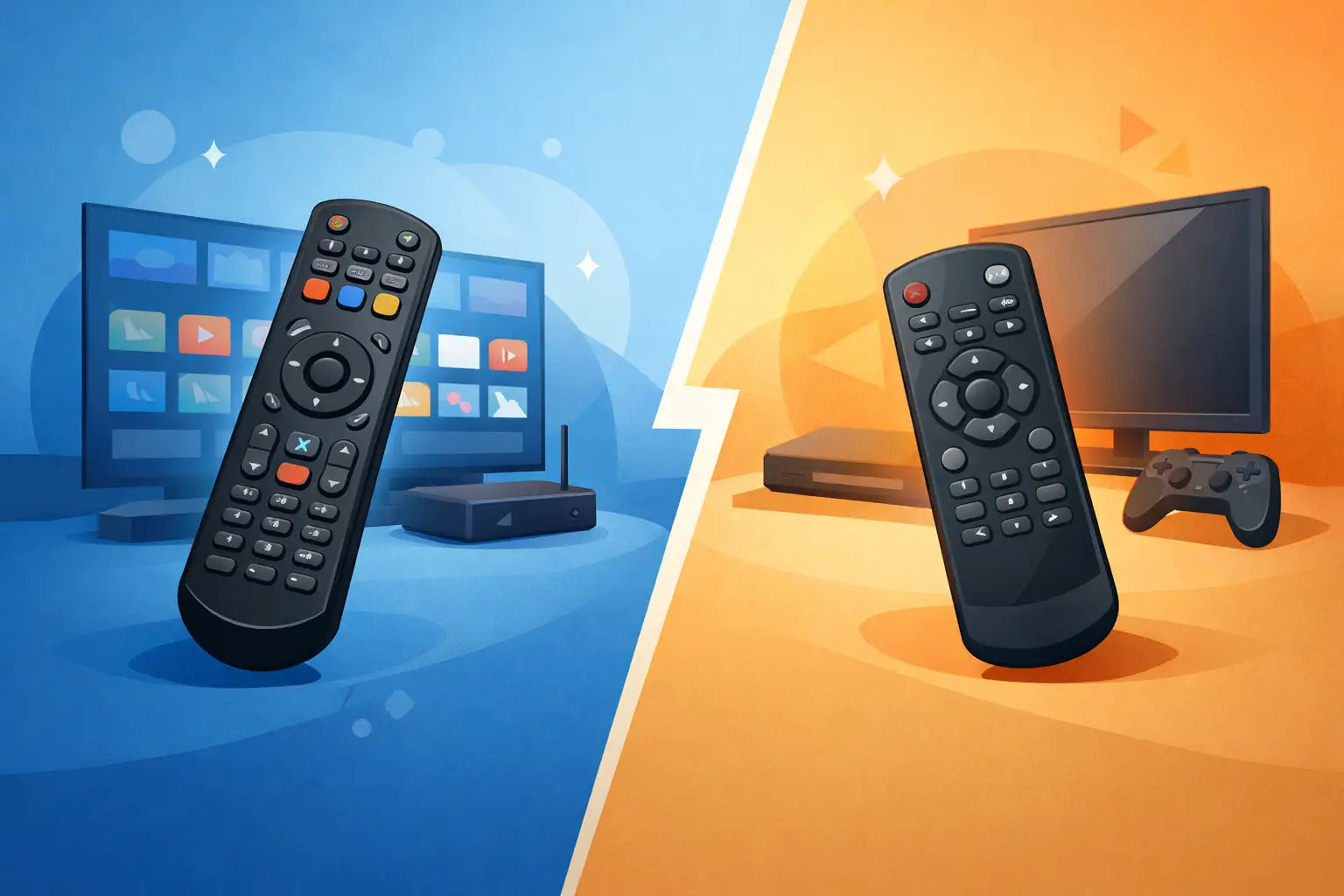
Your remote stops working at the exact wrong moment. The batteries are fresh, the buttons are worn smooth, and now you need a replacement without wasting time or money. That is where the question of universal remote vs original remote matters most - especially if you just want the TV working again by tonight.
For many households, the right answer depends on what you need from the replacement. Some buyers want the simplest possible swap with no setup and all the same buttons as before. Others are happy with a more flexible option if it gets the job done for less. Both types of remote have their place, but they are not interchangeable in every situation.
Universal remote vs original remote: what is the difference?
An original remote is made for a specific TV brand or model range. It is designed to mirror the functions of the handset supplied with the television when it was new. In most cases, that means the layout is familiar, the buttons match what you are used to, and the remote should control the full set of available features.
A universal remote is designed to work with multiple brands. Instead of matching one exact television, it covers a wider range of makes and models through programming, preset codes or automatic setup. That makes it useful when the original handset is lost, discontinued or simply too expensive compared with the value of the TV.
On paper, the comparison sounds simple. Original means exact match. Universal means broad compatibility. In practice, the best choice comes down to setup, functions, price and how confident you are that the remote will do everything you need.
When an original remote is usually the better choice
If you want the closest thing to your old handset, an original-style replacement is usually the safer option. This is especially true for smart TVs, where dedicated buttons and menu functions matter. Services, settings menus, source selection and brand-specific shortcuts are often easier to access on a model-specific remote.
For older customers or anyone buying for a family member, this can make a real difference. If someone is already used to the layout of a Samsung, LG, Panasonic or Philips remote, changing to something with a different button arrangement can be frustrating. An original replacement keeps things simple. You pick the correct model, put the batteries in, and use it much like the one that came with the TV.
There is also less guesswork. You are not relying on code entry or testing different settings. If the replacement is correctly matched to the TV model, it should respond as expected straight away. That is often the quickest route when the priority is convenience.
Original remotes also tend to be stronger when a television has more advanced features. Voice control, recording functions, smart home shortcuts or unusual menu structures may not be fully covered by a universal option. If you regularly use those features, saving a small amount on the handset may not feel worthwhile if the remote leaves you with missing functions.
Where a universal remote makes sense
A universal remote can be the practical choice when you need a working replacement quickly and your needs are fairly basic. If all you want is power, volume, channels, source selection and menu navigation, many universal remotes will cover that without much trouble.
They can also help when the original remote is no longer easy to source. Some televisions stay in use for years after the manufacturer has moved on. In those cases, a universal handset may be faster to find and easier on the budget than chasing an exact original.
This option often suits spare-room TVs, kitchen sets, rental properties and older televisions where you do not need every feature. It can also be useful if you want one handset to control more than one device. That said, the more devices involved, the more important setup becomes. A universal remote can save clutter, but it may take more effort to get right.
Price is another reason people choose universal models. If the TV itself is older and only used occasionally, buying a lower-cost replacement is often the sensible move. You restore basic control without spending more than you need.
Setup is where the experience often changes
The biggest difference in the universal remote vs original remote decision is not just compatibility. It is how much work is needed before you can sit down and use the TV.
With an original-style replacement, setup is often minimal or not needed at all. Once batteries are fitted, the remote usually works immediately if it is the correct match. That is ideal if you want a straightforward replacement with no instructions, no codes and no trial and error.
With a universal remote, setup can range from easy to mildly awkward. Some use automatic code search. Some require manual brand codes. Others work with a pre-programmed list of supported makes. None of that is impossible, but it does add an extra step, and not every customer wants to spend time testing buttons after delivery.
This is one of the main trade-offs. Universal remotes offer flexibility, but flexibility often means a little more effort at the start.
Features and button layout matter more than people expect
Most people think a remote is just a remote until they lose one. Then they realise how much muscle memory is involved. You know where volume sits without looking. You know which coloured buttons open certain menus. You know the shortcut for subtitles, guide or input.
That is where original replacements tend to win. The layout is closer to what you already know, so there is less adjustment. In a busy household, that matters. Nobody wants to explain the new remote every evening.
Universal remotes can sometimes group functions differently or leave out less-used buttons. That may be completely fine if your viewing habits are simple. But if you regularly switch between live TV, apps, HDMI devices and settings, a reduced or altered layout can become annoying over time.
Smart TVs make this more noticeable. Dedicated app buttons, home screens and brand-specific menu controls are not always handled in the same way by universal models. Some perform well enough. Others cover only the essentials. It depends on the remote and the TV.
Compatibility is not something to guess
This is where many buyers come unstuck. A universal remote may claim wide compatibility, but that does not always mean full compatibility. It may control a brand without supporting every menu or smart function. Likewise, an original replacement only works properly if it is matched to the correct television or compatible model group.
That is why model numbers matter. Checking the TV model before ordering is the simplest way to avoid delays and disappointment. It gives you a much clearer idea of whether you need an exact replacement or whether a universal option is likely to be suitable.
For major brands such as JVC, Bush, Logik, Samsung, LG, Panasonic and Philips, there are often several replacement choices available. The right one depends on how closely you want to match the original and which functions you need to keep.
If you are unsure, buying from a specialist retailer with clear compatibility information makes the process far easier. That is often more useful than chasing the cheapest listing and hoping for the best.
Which option gives better value?
Better value is not always the same as the lowest price. A cheaper universal remote is good value if it works properly for how you use the TV. An original replacement is good value if it saves hassle, preserves all functions and lasts well.
For everyday family use, paying a little more for the correct original-style remote can be worthwhile because it avoids setup time and keeps the TV simple to use. For a second television or an older set used only occasionally, a universal remote may be the smarter buy.
The best value comes from matching the remote to the job. If you need a full-featured replacement with no compromise, go original. If you need a quick, affordable fix for standard controls, universal may be enough.
Universal remote vs original remote: how to decide quickly
If the TV is your main set, if the old layout mattered, or if you use smart features often, an original replacement is usually the safer choice. If the television is older, used less often, or you only need basic functions, a universal remote can be perfectly practical.
There is no need to overcomplicate it. Start with the model number, think about how the TV is used, and decide whether convenience or flexibility matters more. That simple check usually points you in the right direction.
At Spares Direct Oldham, the aim is the same either way - helping you get the right replacement quickly, so a missing or faulty remote does not turn into a bigger household nuisance than it needs to be.